mod.io Monthly Dev Diary — May 2025
Revealing a new solution; the mod.io UGC framework! Some work on our multiplayer functionalities, and creator stats going live!
This month in our Dev Diary, we’re revealing some exciting new feature that’s been cooking for a while at mod.io! Which would be an adequate pun to refer to our new Cloud Cooking service which has just gone live, but we’re actually referring to the mod.io UGC framework (modioUGC); a new solution to more easily make your game moddable!
Also, some on-going work on our multiplayer and dedicated server support solutions; and the Creator Stats page we were teasing last month going live.
As always, you can always find the latest in our changelog on Discord, or by keeping up with our GitHub repositories and documentation.
mod.io UGC framework
Dewal, Engineer (Unreal Engine)
Danial, Studio Engagement Engineer (Unreal Engine)
Something that has been identified with partners as a pain point is the process of making their titles moddable. Quite often we see sub-optimal implementations from studios, which can result in poor player experiences.
We’ve set up an initiative to explore developing an opinionated framework which studios could use as a drop-in solution to support modding capabilities in their titles out of the box. This framework is modioUGC, and will abstract away most of the common modding functionality that games desire, making it easier for studios to implement mod support.
We’ve been forging full steam on this project for the past few months, and are now ready to talk about it publicly! We delivered pre-release versions to selected partners for evaluation in Q1, for which feedback has been positive. Last week, we’ve been hitting our feature complete milestone and are beginning to prepare for public release. This is an entirely new produce, and something that hasn’t been available on the market, that we hope can develop into a new standard.
To conduct thorough testing, we’ve integrated modioUGC into our internal Unreal host project: ActionRPG. This serves as a “real world” example to both help us dogfood our plugin, as well as support us to better communicate with partners around implementation details, and better understand the issues they may face, or are already facing. As we’re gearing up for public release, this is also an important step to help identify bugs, and areas of friction before putting it in the hands of more developers.
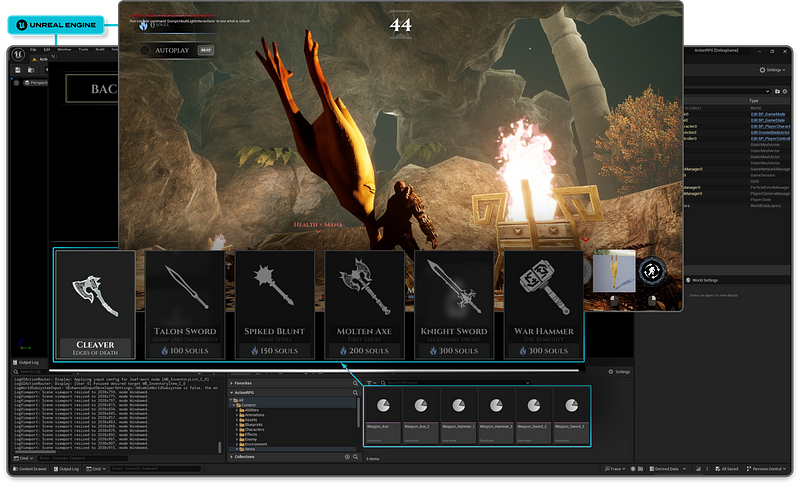
The modio UGC framework is ready for its soft-launch debut and we are setting up a public repository for the plugin, writing documentation and finalizing example integrations to help developers understand how to integrate modioUGC into their own games. To learn more about it, you can already contact our team.
mod.io Multiplayer and Dedicated Server Support
Nicholas Ferrar, Engineer (Unreal Engine)
mod.io support for Multiplayer UGC in P2P and Dedicated Server environments empowers developers to enable out-of-the-box UGC support in their multiplayer games, providing a framework for both modified servers as well as player-specific UGC between games and instances. With a simple to set up and easy to modify approach in mind, this feature-set allows not only developers to host their own modified servers, but also for community run servers to operate modified instances in a self-serve manner with minimal overhead.
The main issues we’re aiming to solve are those of authentication, namely our current framework is built around the idea of a single user being initialized with the SDK and having subscriptions that download UGC as requested. This user can authenticate with email or SSO, however a dedicated server is not a user, but still needs subscriptions/UGC, and cannot authenticate via email or SSO because generally they run in headless environments. Similarly, players will need to join a server and not only acquire the appropriate UGC from it, but also any cosmetic UGC present on other players in the same server (and sharing their own, of course) which they may or may not own, but still need to see, premium or otherwise.
Our current approach is the creation of a OAuth token for the user who “owns” or “runs” the server in question (this can also be the developer themselves, in the case of “official servers”), which will be attached in some way to a list of UGC which the server will be able to access as needed. The issues of initialization and UGC distribution will be solved via some key functions which will initialize the SDK via this OAuth Token (rather than a user) and provide some new methods to untangle the process of using Temp Mod Sets between players and the server. A key goal is to keep our specific implementation as minimal as possible to ensure we can support as wide a range of multiplayer implementations as possible.
Creator Stats page
Vu Nguyen, Frontend Developer
We were teasing it last month, and it’s now live! We have been providing insightful dashboards to creators about their games and UGCs; and have now been extending our insights and data availability to include individual creators, showing statistics that are tailored to each creator’s activity.
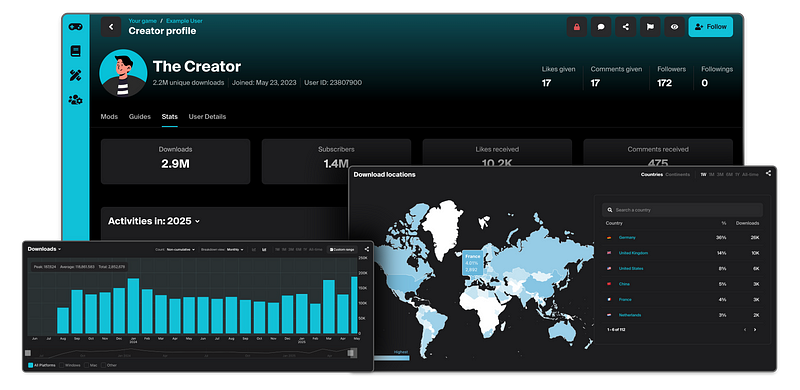
Our Metrics team has gathered data for each creator, and started displaying these stats publicly. This means any user, be it a guest or otherwise, can see any creator activities and statistics. Insightful data about their UGCs across all of the games they have contributed in, presented smartly in the usual manner according to our existing metrics dashboards. Users can view other creators’ top UGCs by various forms of metrics, or how active they are in the scene, both within a single game or across all games that they have created UGCs for. You can find this page live now on mod.io in the user section on our website (see an example).
Exporting data is the next focus for our team, and we will continue to deliver exciting and insightful data to engage users, creators, and keep on the innovation in UGC space.