mod.io Monthly Dev Diary — April 2025
Dive into new functionalities & improvements in development at mod.io. This month: creators metrics, embeddable hub improvements, and more.
As we grow and work with an increasing number of developers, we’ve wanted to dedicate more time to providing our partners with visibility on our ongoing development work. You can always find the latest in our changelog on Discord, or keeping up with our GitHub repositories and documentation, but it doesn’t give you much about the more long term work; essentially, what’s cooking at mod.io?
Introducing a new Monthly Dev Diary format where we’ll highlight some of the work-in-progress from our engineering teams, giving visibility on refinements & improvements of mod.io solutions, and exciting upcoming functionalities & services, and showcasing the work from our team!
A more in-depth and eclectic format; this month, we talk about topics as varied as upcoming creators metrics, improvements to our Embeddable Mod Hub, Meta Quest 3 support, filters expansions, bulk moderation actions, and documentation app migration.
Creators Metrics
Don, Staff Engineer (Data)
Nick “Teddy”, Senior Producer (Web Services)
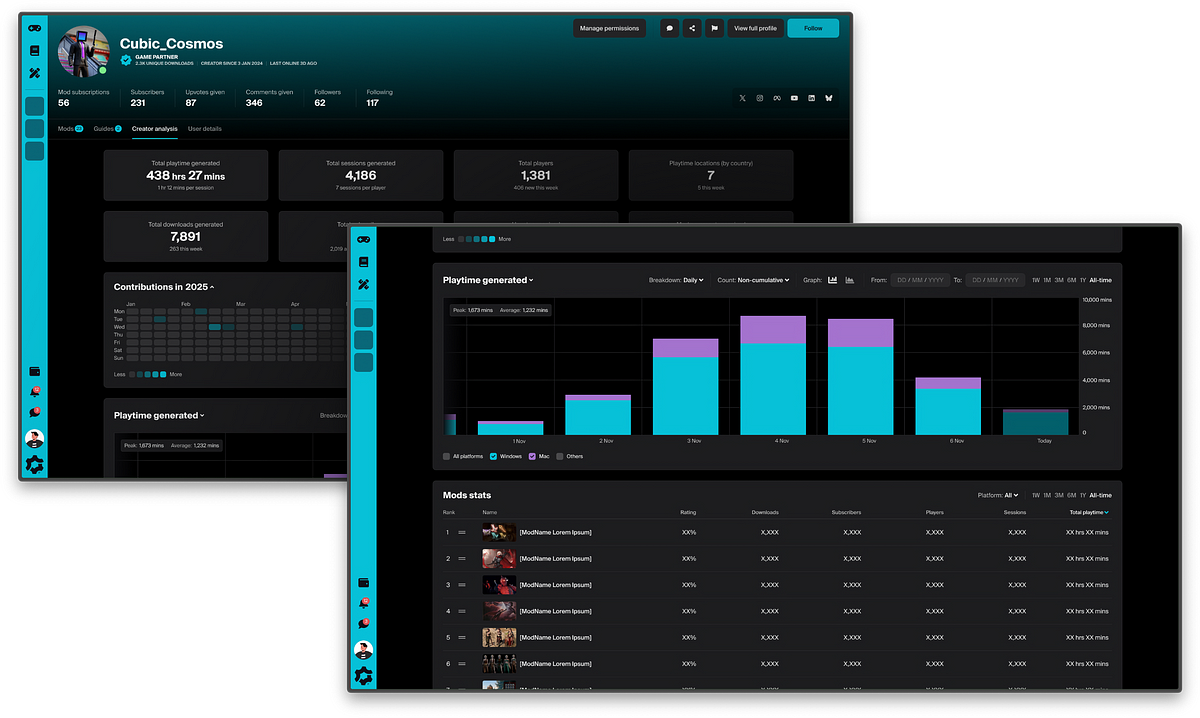
Creator Metrics will be a new tab on Creator profiles, showcasing high-level stats for their mods — such as total subscribers, playtime generated, and more.
For game studios, this feature will encourage deeper player and creator engagement, and provide valuable insight into mod popularity, feature trends, and player behaviour, helping them make informed decisions on mod support, promotions, and community engagement strategies.
For mod creators, this is all about data-driven success. They’ll gain visibility into which mods perform best, where their audience is located, and how engagement evolves over time. This insight can also be a stepping stone toward monetization opportunities, as creators see the full potential of their work.
For players and the community, this aligns with our company’s priority this year: supporting creators. We want to help creators feel the enjoyment players experience with their mods, by showcasing all of the connected activity.
The backend functionality is now complete, and we’re gearing up to build the frontend experience and bring it to life. The attached images showcase our mocked-up designs. Some of the advanced metrics will be an optional premium feature for studios, but improvement & more data will be available for all creators. Details will come once the framework is finalised.
Embeddable Hub creators update
Callum, Tech Lead (Frontend)
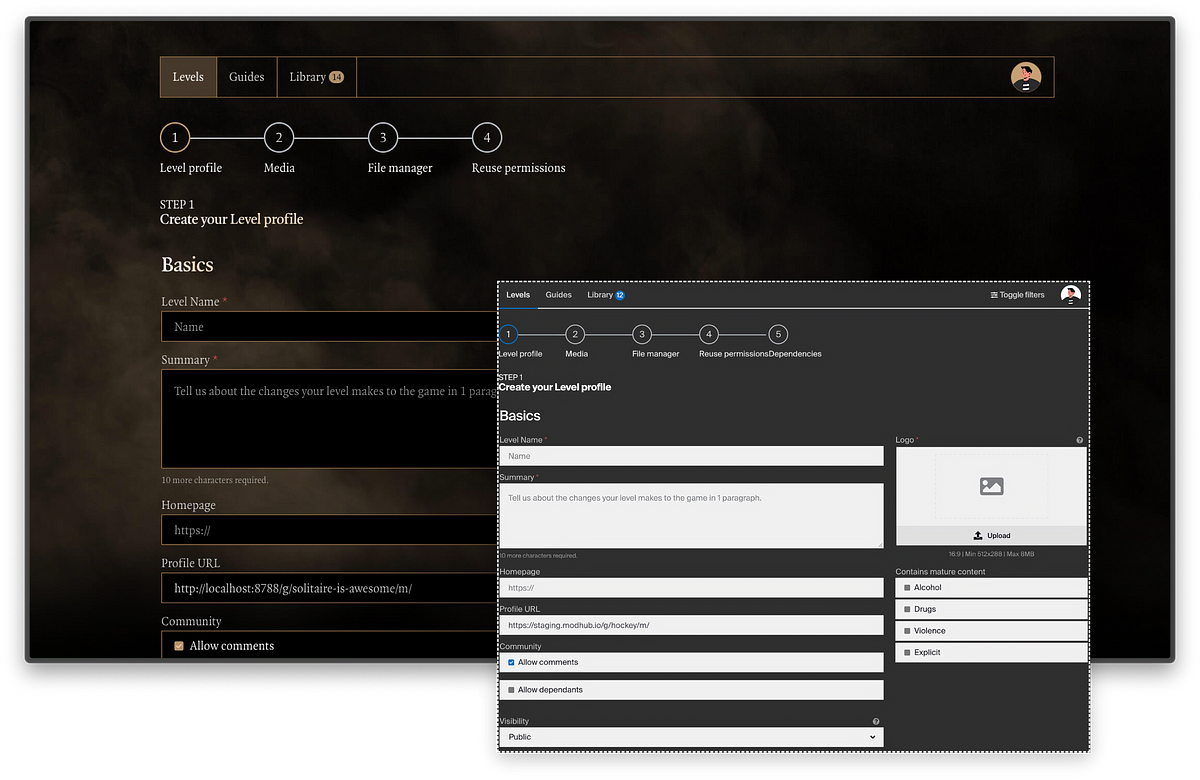
For the last few sprints, our web frontend team has been working on numerous improvements to the Embeddable Mod Hub, with a focus on the add/edit mod flow for creators.
This means creators will no longer be required to upload their content (via the web) exclusively on the mod.io site, and will enable studios to drive more engagement through their white-labelled hub on their own website.
Like a lot of the functionalities within the Embeddable Hub, game admins can toggle on/off these features at will for each of their Hubs.
The first release will focus on the mod settings page where creators can add and edit their mod profile, files, media and dependencies. The add mod flow is live on our internal environment with work on editing to be completed shortly.
In the future we will bring across more features like the ability to edit teams, action reports and even view the metrics dashboard and set up monetization. Our ultimate goal is for developers to be able to run their creator community on their own environment, without having to rely on the mod.io website.
The Embeddable Mod Hub is a premium functionality, if you’re interested in it, please contact us.
Meta Quest 3 Support for Unreal + SDK
Ash, C++ Engineer (Mobile)
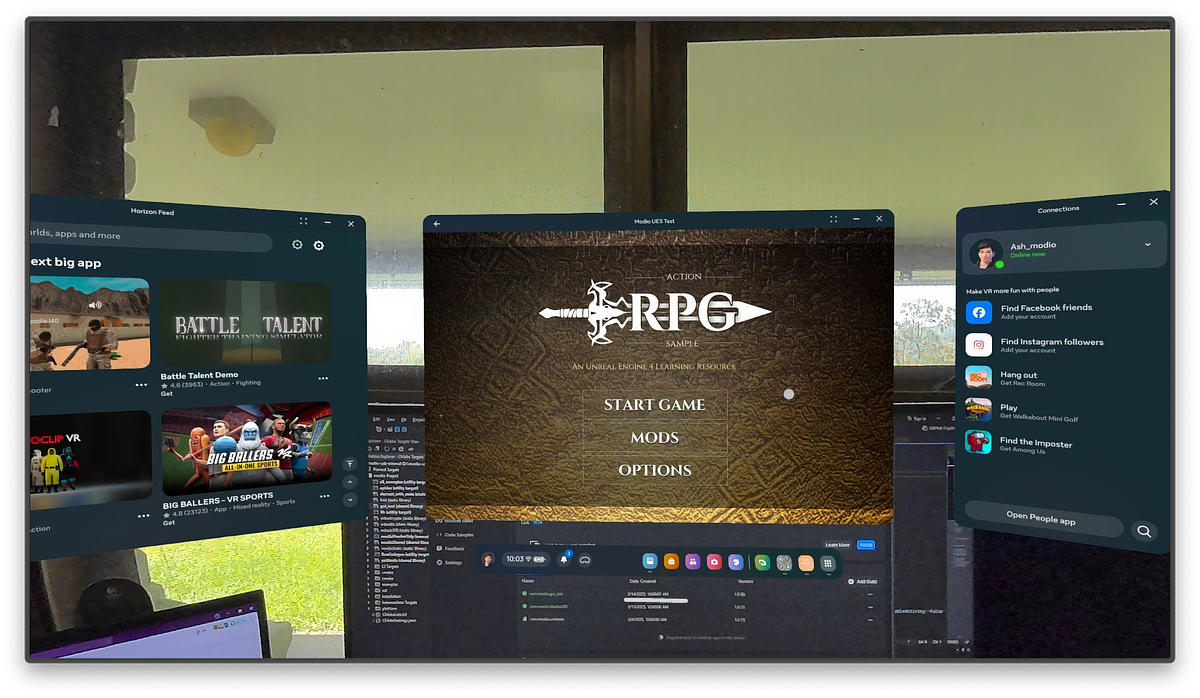
As the demand for VR support continues to ramp on mod.io, expanding and improving our toolset to accelerate the onboarding process and functionality available for all engines has been a priority. The key goal for our initial foray into supporting Meta Quest 3 is platform validation and documentation. While most of this work results in few (if any) changes to the SDK or UE plugin the purpose has been discovery and documentation. They are primarily game-side tasks which I have implemented in our test apps, documenting along the way so that game devs have documentation on how to implement these in their games.
For SDK Base Platform Support we needed to ensure we can build and deploy an app using the C++ SDK to a Meta Quest 3. I used our GUI Test app for this and was able to successfully deploy GUI Test to my Meta Quest 3 as a standard android 2D app. I was able to view mods, subscribe to them, download and install them.
Getting Meta Auth SSO working in an app using the C++ SDK was the next step and again I used our test app GUI Test for this. I added a “Meta Auth” button to the app, and upon pressing it with the Meta controller, successfully authenticated with our backend using my Meta account.
With the SDK building and deploying for Meta Quest 3 — our next step was getting Unreal up to parity. I used our test app for this and was able to successfully deploy it to my Meta Quest 3 and run it as a standard android 2D app. I was able to browse, subscribe, download and install as expected!
We’re still working on Meta Auth SSO working in an Unreal game using our plugin. We’re making great progress with the primary purpose being to document how to do this, so game developers can follow along.
Filters expansion and build improvements
Travis, Senior Engineer (Frontend)
Feedback we have recently received, especially from partners managing large communities, has been the ability to easily bulk search and filter, particularly in the admin dashboards when dealing with content approvals and user reports.
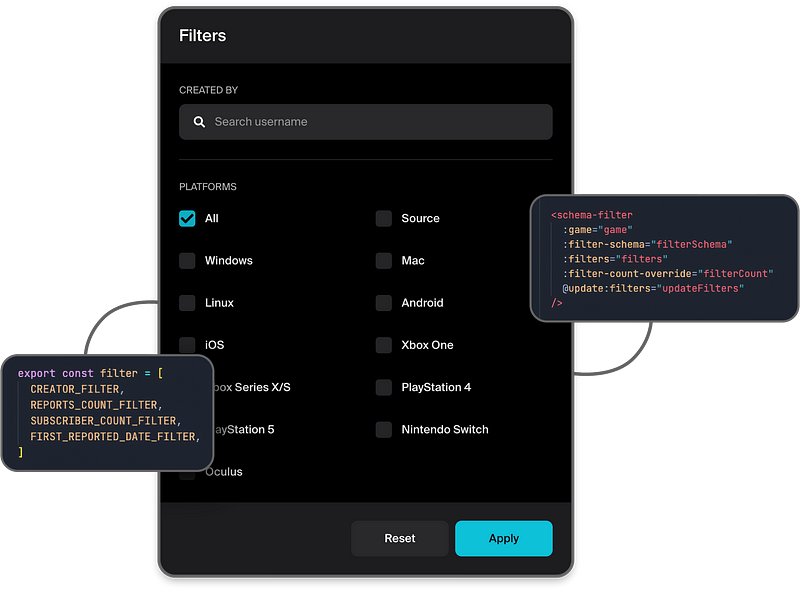
To address this work was recently completed by our Web Services backend team on a big update that added lots of new filters to our report summaries endpoints. Following this we have updated and refined our config driven filtering approach on the frontend to capitalise on this new functionality. We have replaced the previous query builder UI with a new schema generated filter UI.
Now rather than taking in a provided config/schema for available filters and presenting these as options in a query builder using a single row template, we can conditionally create a traditional polished UI with bespoke components that best fit the filter use case.
While the filter UI’s vary between reports for mods, guides and users, instead of hard coding or the user building their own ruleset, these different dashboards are all making use of the same schema driven filtering UI and their individual configs.
This makes supporting and expanding our filters across the site significantly more flexible and scalable moving forward, whilst preserving the best user experience in the process. We have updated the mod and guide moderation dashboards alongside the site admin, game admin and mod admin reports dashboards to all make use of this new component, and plan to roll out further across the site in the future.
Support for Bulk Actions on Mods in the Game Admin Moderations Module
Reece, Staff Engineer (Backend)
Following on from the filter expansion work above, We recently released functionality to support bulk actions in the Reports section of the web app platform, and we’re soon to release phase 2 of these functions. We’ve wasted no time building on top of this and are already in the process of finalizing backend support to make these bulk actions available and accessible for Game Admin-based moderation actions as well. This work is critical for allowing staff and game admins to moderate Mods (UGC) in bulk.
Game moderation teams will be able to complete Approve, Deactivate, Restore, and Delete functions for Mods in bulk via the Moderation modules. This improves efficiency and provides better support for our moderation teams, which is particularly valuable when working with title
As mentioned, the backend support for this feature is in the final stages of development, and we anticipate completion as part of our current sprint. Once finished, the frontend team will scope out their side of the functionality, allowing us to focus on delivering this for our customers. We aim to complete this by the end of the next sprint (mid-April).
Docusaurus migration and improvements
Josh, Senior Engineer (Backend)
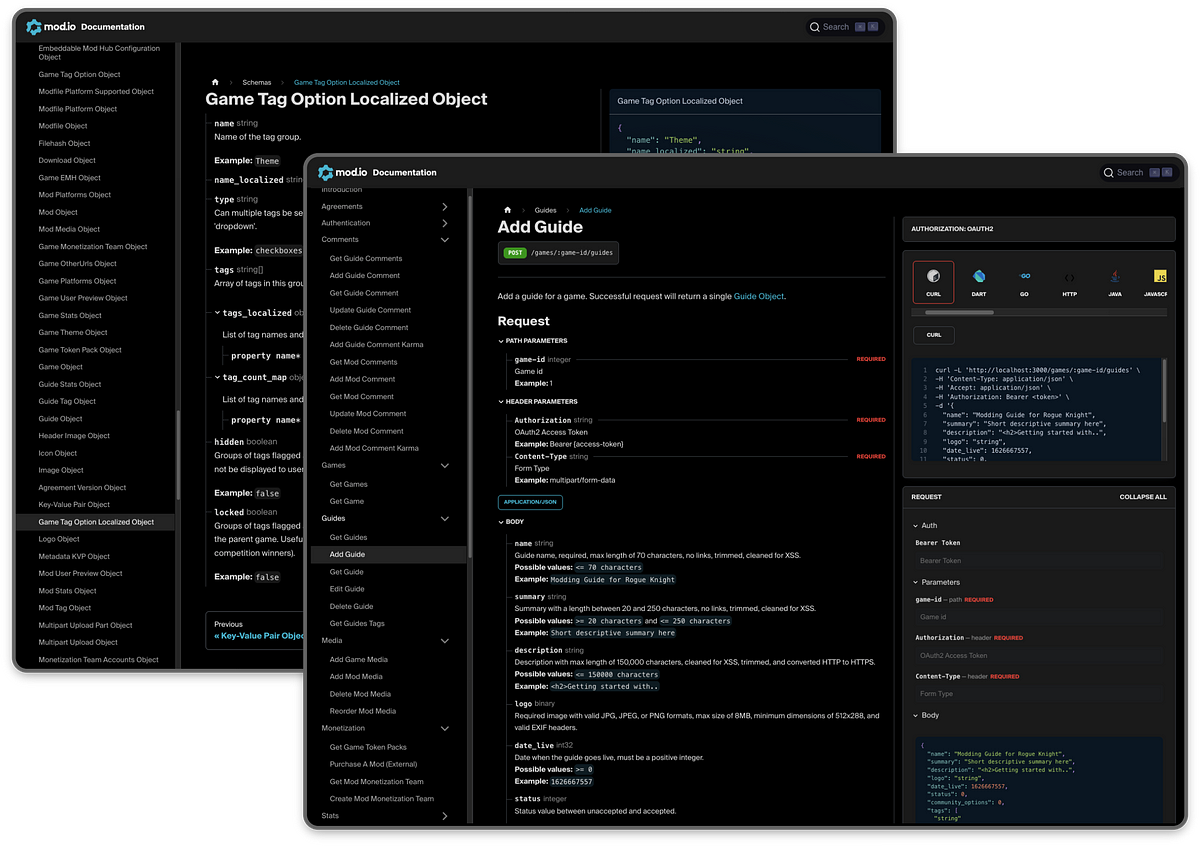
Docusaurus is an advanced documentation generating app we utilise for writing up and sharing our technical information and documentation. We write our information down either in detail or via annotations and it converts them into detailed marked up documents ready to read, searched across, referenced, and shared.
We have been upgrading our instance of documentation to be more up to date version wise, and improved the readability and accessibility whilst opening it up to be more open to upgrades and extensions in future. We have also been porting our RestAPI documentation into this system which included years of previous custom work which had to be rewritten into a new format, some of which requiring manual efforts whilst others could be automated.
Both us and our customers will be able to more easily and efficiently search our own documentation resulting in faster, more accurate outcomes, and we will be better able to upgrade and improve these write ups in future. We have completed the majority of this upgrade and are nearing the end of the project, at which point it will be made both internally and publicly available to all those who need or want access to it.