
Commercial Impact of UGC
How does support of User-Generated Content or mods can impact the commercial success of your game?
It’s commonly accepted that adding User-Generated Content (UGC) and mod support has positive effects for a game. Longevity, retention, community sentiment, you don’t have to dive into the details to identify metrics that will see a positive impact from bringing UGC to the mix. But we’re all about those details, and putting some hard numbers on the benefits of UGC for games. That’s why, last year, we commissioned the game industry insights wizards at GameDiscoverCo to research that question; how commercially impactful is UGC support for games?
Simon Carless and his team ran a study over the top thousand most successful games on Steam (based on estimated revenue and reviews), comparing the results for games including mod support to games that didn’t in their dataset; about 20% of the games matching their criteria did feature UGC support. As self-confessed modding & UGC enthusiasts, we were expecting the results to be good, but they frankly proved to be better than we had anticipated.
23% more Revenue for games with UGC or Mod Support
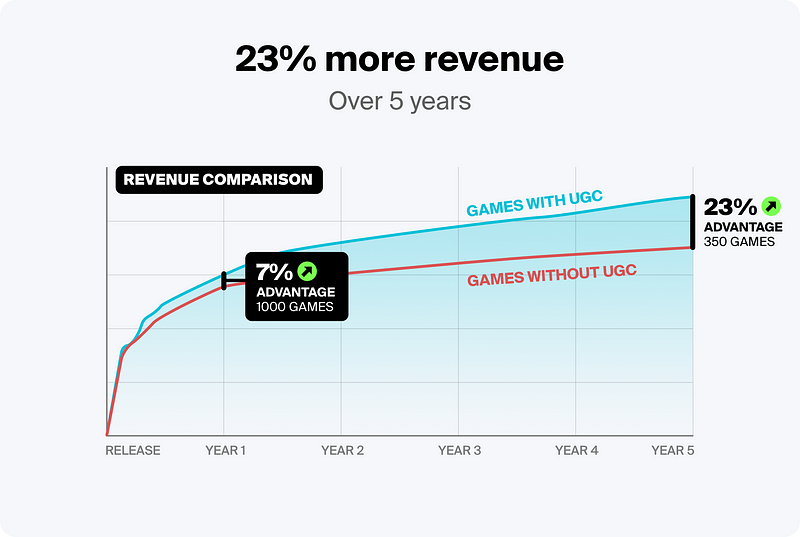
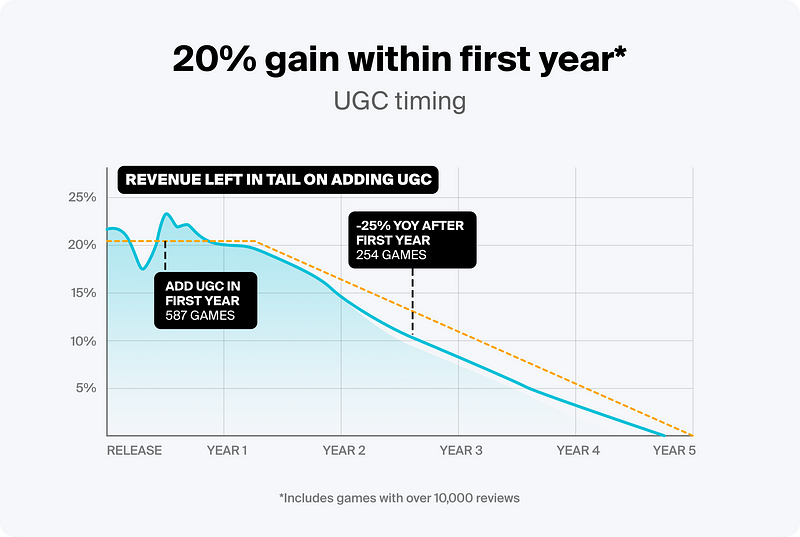
First and foremost, games with UGC support showed a significant revenue advantage over others, 7% more revenue on average after their first year, and reaching 23% after five years. A lift in revenue is observed regardless of when UGC support is introduced, but the impact is stronger when it’s added around release or in the first year of the game being live. After that threshold, there is still a positive impact, but it logically decreases the later the functionality is added to the game.
It’s worth noting that the positive effects above apply to all genres of games! Some game genres see an even higher lift in revenue for UGC-supporting games; for example Action games (+40%) or RPG (+38%). But GameDiscoverCo research found a positive lift of at least 10% for all game genres; including where you wouldn’t necessarily expect it; with a revenue lift of 23% for Casual games, and 28% of Indie games featuring UGC support.
90% Better Retention after 5 Years
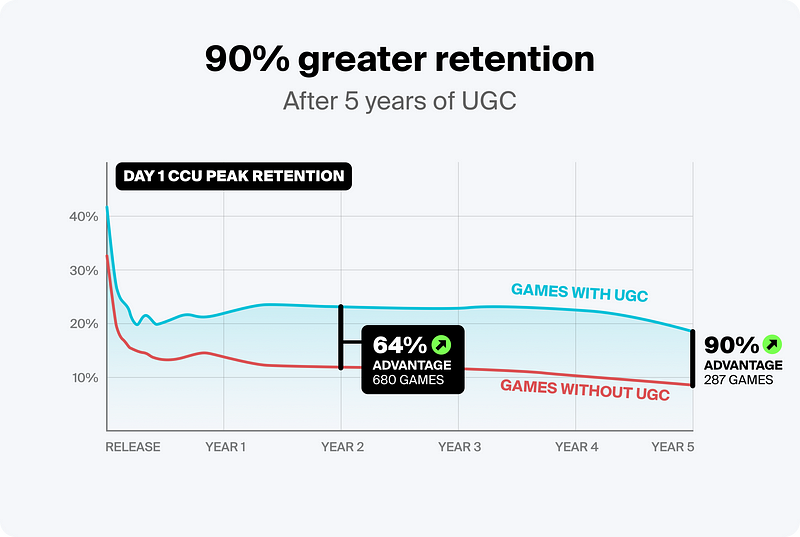
Impact on retention is even more important, with games supporting UGC faring significantly better on the long run than those that don’t. After two years, they display 64% better retention, reaching a staggering 90% retention advantage after five years.
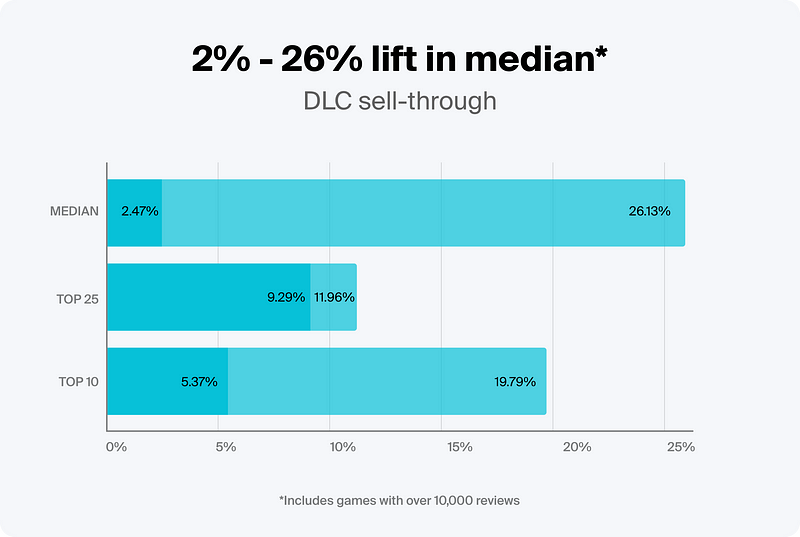
Often the worry is that while providing free content through UGC support will indeed have a positive impact on retention, it might trigger a phenomenon of cannibalization against official content, and impact DLC sales negatively. That notion is dismissed by the data that show better DLC sell-through for titles that support UGC, leading to the superiority in overall revenue. We take these as additional proof that UGC support coexists well with traditional DLC models. Something that’s also been confirmed by our own case studies, for Snowrunner, our partners at Saber observed 2.4 times better conversion in DLC sales for players who engaged with free UGC.
What does that mean for your game?
We’ve been sharing this data with partners for the past year, and while it’s been mostly confirming what people already knew empirically, it’s felt like a final compelling argument for those who still had their doubts about the value of UGC support. Of course, impact will vary based on a game’s success and how UGC integrates with the core player experience. But the bottom line is, positive effects on retention and revenue are very much a given, and thanks to these numbers, can be anticipated and forecasted to an extent.
To leverage this, you should consider adding UGC or mod support to your game, if not on release day, ideally in the roadmap for your first year. This is how you can expect to get the best lift for your results.
Adding monetization to the mix
These are benefits highlighted by GDCo research don’t take into account the additional potential of UGC monetization, which as you know is what mod.io is working on.
We’re developing a variety of solutions, with our marketplace service spearheading in the field, to help support different approaches to UGC monetization that can build efficiently on existing support, adjust to games specifics, and open new revenue streams for developers and creators.
If you’d like to discuss UGC strategy, impact and monetization for your current or future games, reach out to us and we’ll be happy to share best practices and the research on the topic!